Archive for the ‘Feasts of the LORD’ Category

From www.Aish.com. I could not improve on this. The Fast of Gadalia is today, September 19, 2012.

The day after Rosh Hashanah marks the Fast of Gedalia, one of the “minor fast days” in the Jewish calendar year. The fast begins in the early morning at dawn, and ends in the evening at dusk.

What is the meaning of this fast, and why does it occur during the intermediate days between Rosh Hashanah and Yom Kippur?

THE STORY OF GEDALIA- After the destruction of the First Temple 2,500 years ago, the majority of the Jewish people were exiled to Babylon. The conqueror, Nebuchadnezzar, eventually eased some of his harsh restrictions and allowed some Jews to remain in the Land of Israel. He even appointed a righteous Jew named Gedalia to administer the territory. Gradually, more Jews who’d escaped from the horrors of the war into neighboring countries began to return to their homes in Israel.

Gedalia was realistic about the limitations of Jewish sovereignty. He understood that for their own self-preservation, the Jews in Israel needed to fully cooperate with the nation who had conquered their land.

But this political subservience was intolerable to some Jews. A man named Yishmael ben Netaniah, spurred on by jealousy and foreign influence, arose and ignored the King of Babylon. On the third of Tishrei, Yishmael treacherously killed Gedalia as well as many other Jews and Babylonians.

ANSWER ON YOM KIPPUR– In the aftermath of Gedalia’s murder, the Jews feared reprisal from the King of Babylon. They thought to flee to Egypt to save themselves. But since Egypt was a morally corrupt society, the Jews were in a quandary ― weighing the physical threat against the spiritual danger. So they turned to the prophet Jeremiah, who was secluded in mourning, to ask for advice.

For an entire week, Jeremiah pleaded with God for an answer. Finally, on Yom Kippur, he was answered. Jeremiah called the Jews and told them to stay in Israel and everything would be fine. God was planning to make the Babylonians act mercifully toward the Jews, and before long, all the exiled Jews would be permitted to return to their own soil. But, Jeremiah told them, if the Jews decided to go to Egypt, the sword from which they were running would kill them there.

Unfortunately, the prophet’s words did not penetrate, and the people refused to believe. All the Jews remaining in Israel packed their bags and went down to Egypt. They even kidnapped Jeremiah and took him with them! Now the destruction was complete; the Land of Israel was completely barren.

You can guess what happened next. A few years later, Babylon conquered Egypt and tens of thousands of Jewish exiles were completely wiped out. The lone survivor of this massacre was Jeremiah. His prophecy had become painfully true.

The initial event ― the murder of Gedalia ― has been likened to the destruction of the Holy Temple, because it cost Jewish lives and brought the end of Jewish settlement in Israel for many years. The prophets therefore declared that the anniversary of this tragedy should be a day of fasting. This day is the third of Tishrei, the day immediately after Rosh Hashanah.

LESSONS FOR THE FAST OF GEDALIA

Lesson #1 ― The Jewish people had sunk to one of their lowest levels in history. The Temple was destroyed, the majority of Jews were exiled, and things looked hopeless. But God changed their desperate situation and had the righteous Gedalia appointed. Yet Gedalia was murdered by a Jew and all hope was wiped out.

It was at this point that Jeremiah prayed to God for some insight and assurance. This was during the 10 days between Rosh Hashanah and Yom Kippur. This story is memorialized to teach us an important message for these days: No matter how far away you are, you can return and God will forgive you.

Lesson #2 ― The Jews who went to ask Jeremiah for advice were subconsciously sure that God would give the answer they wanted to hear. So when God answered differently, they rebelled. Yet these were not evil people. What happened?

Though these Jews were in one sense dependent on the will of the Babylonians, they were unwilling to be dependent on the will of God. The lesson is that attaching oneself to God means following Him at all times, not just when it happens to coincide with what you want. A good rule in life, when faced with a tricky moral dilemma, is to ask yourself: “What would God say? What does He want me to do?”

Lesson #3 ― When one Jew murders another, it is a deep, terrible tragedy, which can have enormous historical repercussions. There is no excuse for such violence. Do we have philosophical and political differences? We must work them out with calm and tolerance. It is the only acceptable way.

MY TASHLICH EXPERIENCE YESTERDAY

Tashlich ceremony is done on the afternoon of the first day of Rosh Hashanah. Tashlich means ‘to cast off’. ‘cast away’ and is a ritual doen as a physical reminder of the human efforts to cast away one’s sins.

Micah 7:19 reads, “God will take us back in love; God will cover up our iniquities, You [God] will hurl all our sins into the depths of the sea.”

Nehemiah 8:1, “All the Jews gathered as one in the street that is front of the gate of water.” This was believed to be on Rosh Hashanah and the Tashlich ceremony was being observed.

The ceremony is performed beside a body of flowing water, or if there is not flowing water a large bowl of water is used or a mikvah. First you reflect on your short comings or unpaid vows to God the past year and then confess each sin as they have come to your mind and ask forgiveness from God. Next, empty pockets of any lint or crumbs as a symbol of God taking your sins away and throw it into the water.

Prayer, “Who is like You, God, who removes iniquity and overlooks transgression of the remainder of His inheritance. He does not remain angry forever because He desires kindness. He will return and He will be merciful to us, and He will conquer our iniquities, and He will cast off our sins into the depths of the seas. Give truth to Jacob, kindness to Abraham, like that you sore to our ancestors from long ago.”

I did this yesterday on the Texas City Dike beside the ship channel of the Gulf of Mexico. I took communion following my Tashlich observance. The reason this observance is so helpful to me is because I am very introspective, hard on my self and I end up beating myself up and feel I condemn myself. As I observe this ceremony I take communion, receiving the full assurance of my salvation, purchased in full by Jesus Christ on the Cross of Calvary.

When I got home it was pouring rain at the front of my home, no other place, just over the front door. And there was a huge rainbow over our home!!!! How awesome is that??? What a great God we serve.

Rosh Hashanah (Head of the Year) begins tonight at sundown. As the sun goes down, the month. day and year will change. The year will become 5773, marking the years since the creation of man (Adam)

The Feast of Trumpets (also called Rosh Hashanah or Yom Teruah) begins by the blowing of trumpets (shofars or rams horns). There are 100 blasts of the shofar:

  • Tekiah blast“- awakening sound, one long blast (3 second)
  • Shevarim, “broken”- three shorter ones- weeping, lamenting, broken heart
  • Teruah, “alarm”, nine quick blasts in short succession (totaling 3 seconds)
  • These series are blown 11 times for a total of 99 blasts
  • After that, the final blast is knows as Tekiah Hagodolah, “great blast” or “THE LAST TRUMP”! (minimum of 10 seconds)

Rosh Hashanah begins 10 Days of Awe that will end on Yom Kippur, Day of Atonement that begins at nightfall, September 25, which begins Tishri 10 on the Hebraic calendar. Yom Kippur ends the 40 days of Teshuvah (repentance, turning back to God). For 40 days they have been reading aloud Psalm 27, as they make a Chuppah (canopy or covenant covering) over themselves and their loved one. They have also been making restitution to those who they have harmed, giving to the poor and doing acts of kindness. (things we should do daily, but neglect)

At the time of the blowing of the trumpets on Rosh Hashanah, it is believed by the observing Jewish people that these blasts are heard in heaven and 3 books are opened. Malachi 3:16, “Then those who feared the LORD spoke to one another, And the LORD listened and heard them; So a book of remembrance was written before Him For those who fear the LORD And who meditate on His name. (17) “They shall be Mine,” says the LORD of hosts, “On the day that I make them My jewels.* And I will spare them As a man spares his own son who serves him. (18) Then you shall again discern Between the righteous and the wicked, Between one who serves God And one who does not serve Him.” (Also see Revelation 20:12)

  1. Book of the Righteous sealed with the seal of God who would immediately be written for good life the next year (Revelation 3:5)
  2. Book of the Unrighteous, who would be judged during the year; the totally unrighteous whose names are blotted out.(Ps 69:28)
  3. Book of the Intermediate, those who are not completely righteous or wicked. They would have until the Day of Atonement to make restitution and get right with God or they would not be in the Book of Life. (Joel 3:14)

L’Shanah Tovah Tikatevu Literal Hebrew to English Translation: “May you be inscribed (in the Book of Life) for a good year.” This traditional Rosh HaShanah greeting wishes others a good year and is often shorted to “Shanah Tovah” (Good Year).

Years ago, the Rabbis realized that Ha’Satan (The Accuser) actually has the numberical value of the Hebrew letters of 364. They believed that there was one day that Ha’satan did not have access to them, The Day of Atonement which is the day when the blood was put on the Mercy Seat on the Holy of Holies for the sins of the nation.

As a believer, I am spending the Days of Awe praying for our nation, the nation of Israel and for the Jewish people to find Jesus as their Messiah.

Ezekiel 22:30, “And I sought for a man among them, that should make up the hedge, and stand in the gap before me for the land, that I should not destroy it: but I found none.”

How many is our LORD going to find this year? Are you one of those who stand in the gap?

Rosh Hashanah (Head of the Year) began this past Wednesday at sundown, September 28, 2011 which turned Tishri 1, 5772 on the Hebrew calendar. Keep in mind the Jewish day always begins at nightfall. (Gen 1:5b, “And the evening and the morning were the first day”)

The Feast of Trumpets (also called Rosh Hashanah or Yom Teruah) begins by the blowing of trumpets (shofars or rams horns). There are 100 blasts of the shofar:

  • Tekiah blast“- awakening sound, one long blast (3 second)
  • Shevarim, “broken”- three shorter ones- weeping, lamenting, broken heart
  • Teruah, “alarm”, nine quick blasts in short succession (totaling 3 seconds)
  • These series are blown 11 times for a total of 99 blasts
  • After that, the final blast is knows as Tekiah Hagodolah, “great blast” or “THE LAST TRUMP”! (minimum of 10 seconds)

Rosh Hashanah began 10 Days of Awe that will end on Yom Kippur.  Yom Kippur is also called the Day of Atonement begins at nightfall Friday evening October 8 is  Tishri 10 on the Hebraic calendar. Yom Kippur ends the 40 days of Teshuvah (repentance, turning back to God). For 40 days they have been reading aloud Psalm 27, as they make a Chuppah (canopy or covenant covering) over themselves and their loved ones. They have also been making restitution to those who they have harmed, giving to the poor and doing acts of kindness. (things we should do daily, but neglect)

At the time of the blowing of the trumpets on Rosh Hashanah, it is believed by the observing Jewish people that these blasts are heard in heaven and 3 books are opened. Malachi 3:16, “Then those who feared the LORD spoke to one another, And the LORD listened and heard them; So a book of remembrance was written before Him For those who fear the LORD And who meditate on His name. (17) “They shall be Mine,” says the LORD of hosts, “On the day that I make them My jewels and I will spare them as a man spares his own son who serves him. (18) Then you shall again discern between the righteous and the wicked, between one who serves God and one who does not serve Him.” (Also see Revelation 20:12)

  1. Book of the Righteous sealed with the seal of God who would immediately be written for good life the next year (Revelation 3:5)
  2. Book of the Unrighteous, who would be judged during the year; the totally unrighteous whose names are blotted out.(Ps 69:28)
  3. Book of the Intermediate, those who are not completely righteous or wicked. They would have until the Day of Atonement to make restitution and get right with God or they would not be in the Book of Life. (Joel 3:14)

L’Shanah Tovah Tikatevu
Literal Hebrew to English Translation: “May you be inscribed (in the Book of Life) for a good year.” This traditional Rosh HaShanah greeting wishes others a good year and is often shorted to “Shanah Tovah” (Good Year).

Years ago, the Rabbis realized that Ha’Satan (The Accuser) actually has the numberical value of the Hebrew letters of 364. They believed that there was one day that Ha’satan did not have access to them, The Day of Atonement which is the day when the atoning blood was put on the Mercy Seat on the Holy of Holies for the sins of the nation.

As a believer, I am spending the Days of Awe praying for our nation, the nation of Israel and for the Jewish people to find Jesus as their Messiah.

Ezekiel 22:30, “And I sought for a man among them, that should make up the hedge, and stand in the gap before me for the land, that I should not destroy it: but I found none.”

How many is our LORD going to find this year? Are you one of those who stand in the gap? This Sunday is the World Wide Day of Prayer For Jerusalem. Pray for the peace fo Jerusalem.

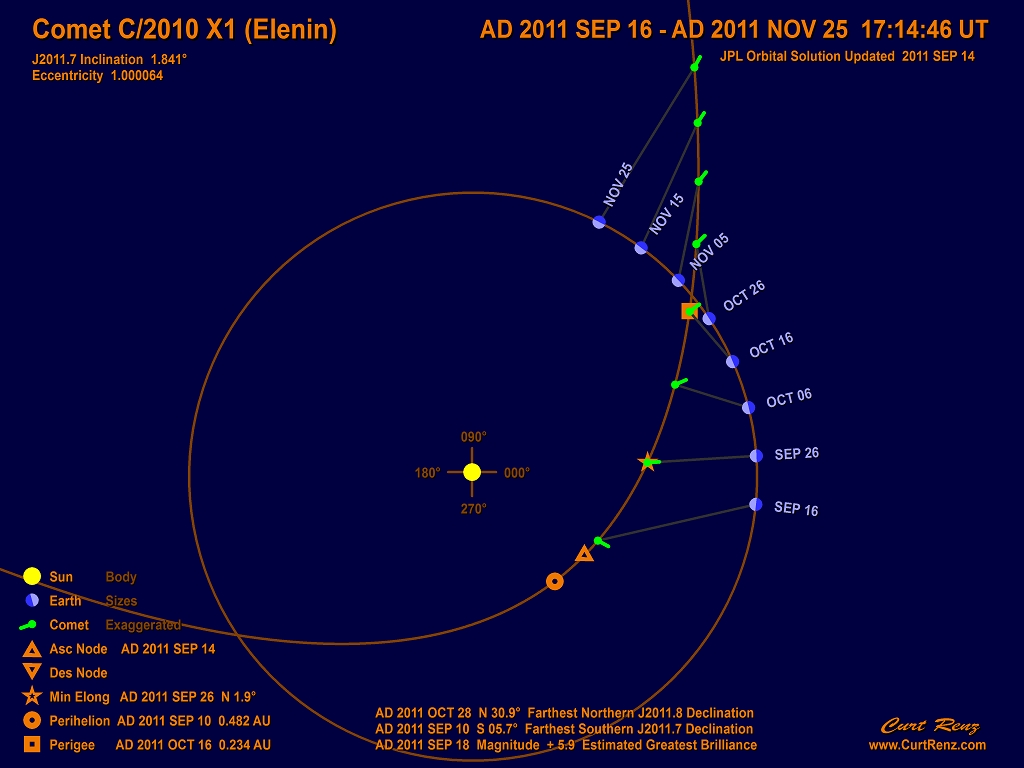
Comet Elenin was discovered on 10 December 2010 by  Leonid Elenin, a Russian amateur astronomer. It will make its closet path to earth October 16, 2011 during Sukkot, the Feast of Tabernacles. The timing of the passes to earth give Elenin its significance. The first pass will be during Rosh Hashanah, September 28-29, 2011 and the second pass during Sukkot.

Astronomer Elenin wrote September 3, 2011: As many readers already know, Comet Elenin has begun the irreversible process of  breaking up.

Comets are ‘big frozen dirt balls’. Newsweek’s article of 1998 regarding Hale Bopp Comet says, “This comet was last seen in these parts 4200 years ago (before Abraham of 2213 BC). “Comets are big frozen dirtballs, an estimated 100 billion of them were created at the same time as the sun and the planets. Most of their days comets float anonymously in a halo called an ort cloud, a backwoods of space way past Pluto. But once in a while gravitational jolts from passing stars send a comet hurdling from the kingdom of ice into a trip around the sun. Comets are of the wandering children of the solar system. They were present at the creation some 4 billion years ago and living in the cold storage in the outer solar system they haven’t changed much.”

God many times will use a comet as a sign of upcoming events. Job 38:22, “Have you entered the treasury of snow, Or have you seen the treasury of hail(23) Which I have reserved for the time of trouble, For the day of battle and war?

Comet Elenin was about 2-3 miles (3-5 km) wide, while the sun is roughly 865,000 miles  (1,392,082 km) across.  This is small compared to the ‘giant’ or larger comets seen in our atmosphere. The Comet of 1729, Comet McNaught (below), Haley’s Comet and Hale Bopp Comet were giants compared to Elenin. (see 9/25/11 blog of Significant Comets)


Below is a chart from Astronomy.com regarding the timing of Elenin’s pass.

The timing of the passings on the Hebrew calendar month make it very interesting. On the 28th it will be the beginning of the moon cycle (head of the month). When the moon begins a cycle and when the moon is full it always affects the earth, such as high tides and more chances of mining accidents. How this will affect the earth is still to be seen. However, all reports are that it has been breaking up and nothing will happen.

Next on the calendar is Comet Garradd……………….9/22/11 – 4/19/12

Pentecost Sundown 6/7/11 (8th & 9th) Ends Sundown 6/9/11. On the Hebrew calendar it is Sivan 6-7, 5771. This is now celebrated as a 2 day Feast since the Rabbis could not agree if Moses went up the mountain on the 6th or 7th of Sivan. This is the 4th of the 7 Feasts listed by God for Israel to keep forever. (Lev 23).

Each of the Seven Feasts of the Lord has a harvest season:

  • Passover is in the spring and is during the barley harvest. It includes the Feast of Unleavened Bread and Feast of First Fruits.
  • Pentecost is in the summer and is the wheat harvest.
  • Tabernacles is the fall and is the grape harvest. It includes Feast of Trumpets, Day of Atonement and Feast of Tabernacles.

An interesting note from the Carta’s Illustrated Encyclopedia of the Holy Temple of Jerusalem by Chaim Richman from page 249: ‘The Mishnah (Taanit 28a) describes how once, in days of the Second Temple, the Roman Empire enacted a decree which outlawed the bringing of firstfruits to Jerusalem. In order to enforce this law, roadblocks were set up on the routes leading to the Holy City.” (My thoughts, did this happen after the Holy Ghost fell in Acts 2 and they were afraid it would happen again?) Because of this, they began bringing their firstfruits on Av 15, when all the seven firstfruits of the season had ripened.

Many Christians ask the question of what is the difference between the Jewish Pentecost and Christian Pentecost Sunday.  The answer is simple,  Jewish Pentecost follows 50 days after the 2nd day of Passover. The Christian Pentecost follows 7 weeks after Easter Sunday. The calendar that God instituted in Exodus 12 is  a lunar calendar and this is the calendar to follow to keep aligned with God’s Feast seasons and His signs for these last days.

FEAST NAMES

  • Shavu’ot – This is the main Hebrew name, meaning ‘weeks‘, representing the 7 weeks following the 2nd day of Passover when the omer begins to be counted.
  • Pentecost– Greek, pente means 50, representing the Holy Day following 50 days after Passover
  • Festival of Weeks– Chag HaShavuot
  • Festival of the Giving of the Torah (Chag Mattan Torateinu)
  • The Day of First Fruits– Yom HaBikurim, Numbers 28:26, when the firstfruits of the wheat harvest is brought to the Temple
  • Feast of the Wave Loaves– Leviticus 23:17. During the times of the Temple, the priests would wave two loave of bread, baked with the fine wheat flour. NOTE: records show the leavened loaves each had 4 lbs of flour (½ gal) and were 28″ long.

BIBLICAL HISTORY OF PENTECOST

Exodus 19-20. Exodus 19 begins with “In the third month, when the children of Israel were gone forth out of the land of Egypt, the same day came they [into] the wilderness of Sinai.” The counting of the months began in Exodus 12:2 when God told Moses, “This month [shall be] unto you the beginning of months: it [shall be] the first month of the year to you. ” This began God’s calendar, known as the biblical calendar. The other calendar, which I call the civil calendar,  begins 6 months later in the month of Tishri when the Hebrew year changes, following the years since Adam’s birth.

God told Moses, as recorded  in Exodus 3:12, “And he said, Certainly I will be with thee; and this [shall be] a token unto thee, that I have sent thee: When thou hast brought forth the people out of Egypt, ye shall serve God upon this mountain“. The Hebrew children left Egypt the day after the first Passover and they were now at the mountain to meet with God, 44 days later. Now they were to prepare themselves and wait for God’s appointed meeting.

On the 3rd day, God spoke to the Hebrew children from the mountain.  Ex 19:16, “And it came to pass on the third day in the morning, that there were thunders and lightnings, and a thick cloud upon the mount, and the voice of the trumpet exceeding loud; so that all the people that [was] in the camp trembled. (18) And mount Sinai was altogether on a smoke, because the LORD descended upon it in fire: and the smoke thereof ascended as the smoke of a furnace, and the whole mount quaked greatly. (19) And when the voice of the trumpet sounded long, and waxed louder and louder, Moses spake, and God answered him by a voice.” At this time they were orally given by God the 10 Commandments, but they were fearful of God of God and told Moses to talk to God for them. On the 6th day Moses went up the mountain and did not come back for 50 days.

  • This is known as the time when Moses was given the Torah.
  • This is also when God made covenant with Israel. He made covenant with Abraham, Isaac, Jacob and the land- but now His covenant is also with the entire nation. This is when the nation of Israel was born.
  • This is considered to be the time of God’s marriage to Israel since marriage is a covenant relationship.
  • More information is recorded in Exodus 19 & 20, 23:15-19; Leviticus 23:16; Deut 26:5-11;  Ruth 2:23

During the time of the Temples they would bring their firstfruits of wheat to the Temple and present them to the Lord. They would recite Deuteronomy 26:5-11 to the priest, present the basket at the altar and law prostrate before the Lord.

On Pentecost Exodus 19-20 is read and the Scroll of Ruth is read in its entirety. The beautiful story of Redemption is found in Ruth and it takes place during the wheat harvest (Pentecost). It is a recording of Ruth and the kinsman redeemer Boaz, the only one who could redeem the land Naomi’s family lost and save her and Naomi. It is also a joining of a Gentile & Jew – traditionally the marriage of Ruth & Boaz was on Pentecost. King David’s beginnings- believed to have been born and died on Feast of Shavuot (70 yrs) and is the great-grandchild of Ruth and Boaz.

On this day meals include dairy and honey, representing the promise of a land full of milk and honey. Mothers will dip their finger in honey and touch the baby’s tongue, telling them ‘God’s word is as sweet as honey’.

Tradition is to stay up all night studying the promises in God’s word regarding opening heavens. Scriptures included Joel 2, Zech 12:10a, Isaiah 44:3, Ezekiel 1:4; 3:12-13; 36:26-27.

In services of Sephardic Jewish congregations read a ketuba, ‘wedding contract’ . Pentecost being the marriage covenant to Israel.

SEVERAL SIMILARITIES TO THE FIRST  PENTECOST AND ACTS TWO

God’s specified appointment

Jesus’ specified appointment

Waited in obedience

Waited in obedience to Jesus

Prepared to hear from God

Prepared for power from on high

One mind & single heart

In one accord in one place

Waited at the base of the mountain

Waited in Jerusalem

Nation was birthed

Church was birthed

God gave the Law to teach them what was right

God gave them the Teacher

God’s laws were written in stone

Written in their hearts

Heavens opened and Moses went up

Heavens opened and Spirit came down

Great thunder, lightning, trumpet

Sound of a mighty rushing wind

People went from being slaves to a nation of priests

Disciples went from following to leading (apostles)

Twin loaves waived at the 3rd hr

Acts 2:15, seeing it is the 3rd hr

3,000 died when the tablets were broken due to the golden calf

3,000 religious Jews were born again after Peter preached

Leviticus 23:36, “Seven days ye shall offer an offering made by fire unto the LORD: on the eighth day shall be an holy convocation unto you; and ye shall offer an offering made by fire unto the LORD: it [is] a solemn assembly; [and] ye shall do no servile work [therein].”
Shemini Atzeret means “The Assembly of the Eighth (Day); Shemini, #8066 (shem-ee-nee) means eight; Atzeret, #6116 (ats-aw-raw) means an assembly”. Rabbinic Literature says that God came to tabernacle with His people for 7 days and had such a good time He decided to stay for another day.
John 1:14,  “And the Word was made flesh, and dwelt among us, (and we beheld his glory, the glory as of the only begotten of the Father,) full of grace and truth.” The Greek word for dwelt is skenoo, and means ‘to fix one’s tabernacle, have one’s tabernacle, abide (or live) in a tabernacle (or tent), tabernacle’. Jesus, being the express image of God, loved us so much that He came to Tabernacle among us and make a way to be with Him throughout eternity. Jesus is the Word made flesh. The Eight Day Assembly is all about ‘dancing with the Word’.  There is a wonderful song called “DANCE WITH ME O LOVER OF MY SOUL.” It is a beautiful song of Ruth and Boaz, and we can see the story of our Messiah & the Bride of Christ.

Josephus records in Antiquities, 3.10.4.24, “On the eighth day all work was laid aside…..”  Even though this is the Eighth day of the assembly, it is a seperate holy day in itself. They do not take the lulav & etrog on Shemini Atzeret

This is the time of the “Rejoicing of the Torah” Today they give a sacrifice of praise! They rejoice in the Lord and dance with the Torah!

In synagogues around the world, men will be dancing carrying the Torah Scrolls, children will be carrying toy scrolls. There will be much rejoicing and merriment as they worship God with their praise & thanksgiving for the Holy Word.

Hosea 4:6 says, “My people are destroyed for lack of knowledge: because thou hast rejected knowledge, I will also reject thee, that thou shalt be no priest to me: seeing thou hast forgotten the law of thy God, I will also forget thy children.”

  • The people were destroyed when they had a lack of knowledge of God’s way of doing and being right
  • Deuteronomy 31:10-12, hear, learn, do all the words of the Torah (law, teaching)
  • Micah 4:2, “And many nations shall come, and say, Come, and let us go up to the mountain of the LORD, and to the house of the God of Jacob; and he will teach us of his ways, and we will walk in his paths: for the law shall go forth of Zion, and the word of the LORD from Jerusalem.”
  • Read Nehemiah 8:1-3, 8, 13-15, 18

Torah, #H8451 (to-rah) from #H3384, (yaw-raw), a prime root meaning “to flow as water, to rain; to point out (as if by aiming the finger), to teach. The Torah refers to the Books of Moses, the first 5 books of the Old Testament written by Moses during the Wilderness years.

Water is compared to the Torah, which descends from a high place to a low place bringing life, refreshing, blessing.

  • Ezekiel 34:26, cause rain to come down in his season, showers of blessing
  • Psalm 72:6-8, He shall come down like rain on mown grass, like showers that water the earth
  • Habbakkuk 2:14, “For the earth shall be filled with the knowledge of the glory of the LORD, as the waters cover the sea.”

In Mark 4 & Matthew 13 the parable of Jesus teaching about the ‘sower and the seed’ is recorded. Matthew 13:19 reads, “When anyone hears the word of the kingdom, and does not understand it, then the wicked one comes and snatches away what was sown in his heart. This is he who received seed by the wayside.”

May you rejoice in the Living Word as He teaches you and gives you understanding. Shalom

Leviticus 23:39, “Also in the fifteenth day of the seventh month, when ye have gathered in the fruit of the land,  shall keep a feast unto the LORD seven days: on the first day [shall be] a sabbath,  and on the eighth day [shall be] a sabbath.”

During the times of the Temple, Jerusalem was known at “The Light of the World”. In the Court of the women were 4 enormous candlesticks with 4 golden bowls at the top of each. They were 75′ high! They used worn out priestly garments for wicks that they had cut into strips and would pour in oil from 7 gal buckets. Four young priests-in-training would climb to the top, carrying immense oil jugs with which they would fill the bowls. Once lighted, there was not a courtyard in all of Jerusalem that did not glow with the light that emanated from the celebration in the Temple courtyard. (In another reference it says each bowl held 10 gallons of fresh oil)

For the cememony of the 7th Day, the Priests were put into 3 groups: The First group was responsible for the daily sacrifices.

The Second group was headed by the High Priest went out the Water Gate to the Pool of Siloam which had “Living Water”! One assistant had a silver pitcher of wine (silver representing redemption). At dawn, the assembly proceeded with melody and song to the spring of Siloam, at the foot of the walls of Jerusalem.  There the high priest had a golden vase (representing royalty, divinity) and drew the water known as the living water (mayim hayim) and held it in the vase. His assistant held a silver vase containing wine. The high priest took the special golden decanter and filled it with the living water.

This ceremony with prayers represents asking God, who is in charge of the rain, would grant the rainfall for the next  year. When the water was being poured they would sing, “When the water was poured they would be singing, “Save now, I pray, O Lord, O Lord, I pray, send now prosperity. Blessed is he who comes in the name of the Lord.” (Psalm 118:25-26) The day is named after thier cry, Hosheana (“save now”) which was repeated 7 times.

The Third Group of priests went out to the Beautiful Gate to the Matzah Valley and cut willow branches 25-30′ in length. Like a parade they would form rows of priests 30′ apart waving the branches. At the same time both groups would meet with the water and branches and march back to the Temple. This was symbolic of the Spirit coming to Jerusalem (the living water and the spirit were coming at the same time)

Then certain priests would blow their trumpets and all the Levites and people waved palm branches while singing from Psalm 113-118. Those carrying the long branches would make a “swishing sound” as they waved them back and forth. This represented the Ruach (spirit) wind.

Once they arrived at their gates a priest known as “the pierced one” played a flute calling for the Wind and Water to enter the Temple. (Zech 12:10; John 19:34)

Then the congregation with the Second Group of Priests ascended again to the Temple, led by the high priest who bore the golden vessel. Arriving at the Temple, he brought the decanter up to the altar, and poured the water into the silver cup at its corner. Another priest poured out wine from the other decanter into the cup at the opposite corner. 

Before they reached the altar with the water they turned to face the altar and remembered Ezekiel 8:16, “So He brought me into the inner court of the Lord’s house; and there, at the door of the temple of the Lord, between the porch and the altar, were about twenty-five men with their backs toward the temple of the Lord and their faces toward the east, and they were worshiping the sun toward the east.”

Special Commandment of the Willow

The worshipers would place exceptionally long willow branches from Motza, on the outskirts of Jerusalem all along the foundations of the altar with the heads bent over the top.  This daily ritual was accompanied by trumpet blasts and the sounding of the shofar by the priests and Levites.  The priest would circle the altar once each day holding the lulavin and praying to the Almighty, the 7th day they would circle 7 times remembering the walls of Jericho.

We find a record of what Jesus said on Hoshana Raba, as the water was being poured out on the altar. John 7:37, “On the last day, that great [day] of the feast, Jesus stood and cried out, saying, “If anyone thirsts, let him come to Me and drink. (38) He who believes in Me, as the Scripture has said, out of his heart will flow rivers of living water.”(39) But this He spoke concerning the Spirit, whom those believing in Him would receive; for the Holy Spirit was not yet [given], because Jesus was not yet glorified.” 

Here Jesus is making a bold statement, “I am your Hosanna, I am your Salvation. I will give you living waters of the Spirit. Jesus came to satisfy a spiritual thirst that could be quenched no other way. The Pool of Siloam is called “sent” and Jesus was the “sent one”.  John 7:16, “Jesus answered them and said, “My doctrine is not Mine, but His who sent Me.” (John 7:28, 29, 33)  (The word ‘sent‘ is the Greek word Apostello, where we get the word apostle)

Leviticus 23:27, “Also on the tenth [day] of this seventh month [there shall be] a day of atonement: it shall be an holy convocation unto you; and ye shall afflict your souls, and offer an offering made by fire unto the LORD. (32) It [shall be] unto you a sabbath of rest, and ye shall afflict your souls: in the ninth [day] of the month at even, from even unto even, shall ye celebrate your sabbath.”

This is the most serious day on the Jewish Calendar. God wanted His chosen people to be holy (kadosh – set apart, sanctified), seperated from sin and the heathen influences of the world.

Yom Kippur, also known as  Yom Hakippurim (which means the day of covering or concealing), the Day of  Atonement, The Fast, The Great Fast, Day of the Covering, Face to Face (my favorite name); Day of Forgiveness, Day of Grace, or the Day of Judgment.

In history, this is the day that Moses came down the mountain after the 2nd set of 4o days when he spent his time interceeding for the nation of Isreal because of the sin of worshipping the Golden Calf. He went up the mountain after this idol worship incident on Elul 1 (when Teshuvah begins) and descended 40 days later on Tishri 10. When he came down he had the 2nd set of the 10 Commandments. The Atonement (Hebrew – chaphar, to cover, make reconciliation, to pacify or appease; to clear, purge or cleanse) was made at that time for the nation, one righteous man standing in the gap for the entire nation.

Moses said to HaShem: (Exodus 32:32) “Yet now, if thou wilt forgive their sin–; and if not, blot me, I pray thee, out of thy book which thou hast written. (33) And the LORD said unto Moses, Whosoever hath sinned against me, him will I blot out of my book.” Notice the word “sin–” with the dashes behind it. That implies a sudden silence. The Midrash comments, “Whether of not You forgive the, take away my personal merits from Your ledger and assign them to the credit of Israel.”

The forgiveness for the nation once a year had to be made by the High Priest, where he would come ‘face to face’ with the glory of God in the Holy of Holies. The ransom sacrifice had to made by blood, because the only thing set apart from the foundation of the earth as an answer to sin was blood. The Israelites were not to touch blood, drink blood or eat an animal with the blood.

Leviticus 17:11 reads, “‘For the life of the flesh is in the blood, and I have given it to you upon the altar to make atonement for your souls; for it is the blood that makes atonement for the soul.”

 Exodus 32-34 is a record of Moses on the mountain and Exodus 34:28-29 records, “So he was there with the LORD forty days and forty nights; he neither ate bread nor drank water. And He wrote on the tablets the words of the covenant, the Ten Commandments. Now it was so, when Moses came down from Mount Sinai (and the two tablets of the Testimony were in Moses’ hand when he came down from the mountain), that Moses did not know that the skin of his face shone while he talked with Him.”

THE SCRIPTURE LISTS FOUR OBSERVANCES TO BE CARRIED OUT ON THE DAY OF ATONEMENT:

  1. HOLDING A CONVOCATION: A special gathering in the synagogue would begin before sundown with people coming together, some dressed in white kittels (robes, as a symbol of  a contrite heart, Is 1:18) with men wrapped in prayer shawls. Some carry a candle as they chant “Light is sown like seed for the righteous and gladness for the upright in heart.” (Ps 97:11) The candles remind the people that God is searching their hearts (Pr 20:27) The evening service begins with Kol Nidre, repeated 3 times, increasing in volume- then chanted by the Canto.  (http://www.youtube.com/watch?v=dSzCJh4Pq8I&feature=related) Hearts are searched and there is personal repentance for unfulfilled vows, and wrongs done the past year.
  2. HUMBLE YOUR SOULS: Everyone, according to their personal health, will abstain for 25 hours from partaking of food, drinking.
  3. PRESENT AN OFFERING: Sacrifices to God, since there is no Temple to sacrifice, people give an offering to God of money
  4. NO NOT WORK: Work is forbidden on Yom Kippur. The Rabbi is the only one allowed to work. (Lev 23:31,
    You must do no work at all! This is a permanent law for you, and it must be observed wherever you live.”)